The Illusion of Learning
I asked an AI to summarize a book about how people learn. It took me a second to notice what I had just done, and longer to work out why it bothered me.

Every time access to information got cheaper, someone announced that everyone was about to get smarter. The printing press. Public libraries. Encyclopedias. Google. Now generative AI. Access got cheaper every single time. Understanding never did.
I went looking into how people actually learn this week and found a book on it from 1984. Then I asked an AI to summarize it.
It took me a second to notice what I had just done.
I have been sitting with that since. Not because it was a mistake exactly. The summary was good. I could tell you what the book argues right now, today. But I also know that in a week I will not be able to, and that has been true of almost every summary I have ever consumed. Meanwhile there are books I read years ago that I can still argue with, badly, from memory.
That gap has to mean something.
Fluency is not the same as understanding
What I keep circling is this: fluency feels like competence. A clean summary hands you the exact sensation of understanding while skipping whatever creates it. Nothing warns you. The feeling arrives complete.
The one idea from that book that stopped me was a distinction I had never seen drawn so cleanly. We treat learning as a single line from ignorant to informed. It is actually two separate axes. One runs from rote to meaningful, whether the new thing hooks onto what you already know or just sits there loose. The other runs from received to discovered, whether you were handed the conclusion or arrived at it yourself.
Those are not the same axis, and mixing them up is the whole trap. A six hundred page book read passively is still rote. A three paragraph summary can land as real knowledge, but only if you already hold the structure to hook it onto. Which means the format was never the thing that mattered. What mattered was whether anything of yours was on the table when the idea arrived.
A summary quietly removes that. It hands you the conclusions with the reasoning stripped out and none of the events that produced them. You can restate it perfectly. You cannot tell when it is wrong, or when it does not apply, because you were never there when it was built.
And I am not standing outside this. I have built more machines that compress things on my behalf than most people I know. This is my own habit, not somebody else's problem.
Faster is not the same as better
So when I hear that AI is making everyone smarter, it does not sit right, and I think I finally understand why. It is making us faster. Those are not the same thing, and I am not sure we have noticed the substitution.
Here is the part that actually unsettles me. AI helps most the people who need it least. If you already understand a domain, it makes you faster, because you can tell when the output is wrong. If you do not, it hands you confident, fluent output you have no way to check. It widens the gap between those two people. It does not close it.
Where I have landed, for myself at least: I do not think reading was ever about getting information. I think it was about being changed by it. The machine took the first part. It cannot touch the second.
Still working out what to do about that. The only book on my nightstand right now is science fiction, which I keep there specifically so I do not have to think.
Make of that what you will.
The ideas about rote versus meaningful and received versus discovered learning come from Joseph D. Novak and D. Bob Gowin, Learning How to Learn (Cambridge University Press, 1984).
Thanks for reading.
Notes on AI-native products, platforms and operating models, from twenty years of building technology that pays its way. If this one landed, let's talk.
More writing
All writing →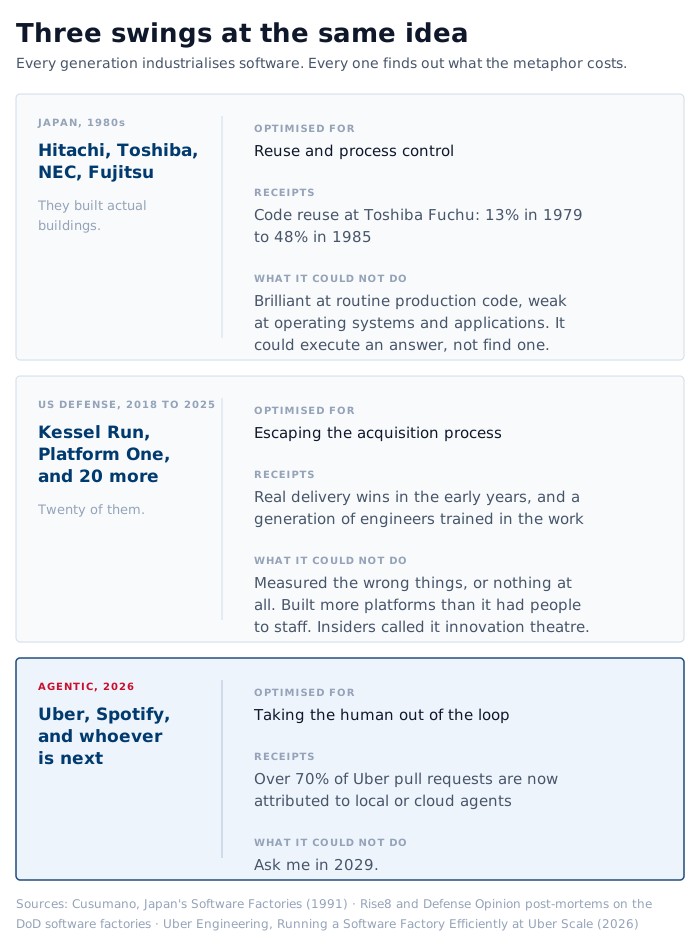
Software factories were tried in 1980s Japan and again across US Defense. Both fell short in the same way. The agentic version in 2026 is different in one specific respect, and it is not the agents.
Read
Most engineering orgs added AI but kept the rituals built for a slower era. Here are eleven things to retire this quarter, and what to replace them with.
ReadMost teams added AI to sprint workflows that no longer fit. Here's the new cadence AI-native teams run on: rituals, rhythm, and the metrics that anchor it.
Read