AI-Native Engineering Cadence: What Replaces Sprints
Most teams added AI to sprint workflows that no longer fit. Here's the new cadence AI-native teams run on: rituals, rhythm, and the metrics that anchor it.
Most engineering teams adopted AI tools, kept their sprint ceremonies intact, and assumed the rest would sort itself out. It did not. The sprint cadence was designed for human-paced execution, and it does not survive contact with AI-native workflows. Teams that ran the experiment honestly noticed within a quarter: standups got more performative, retros got more circular, velocity reviews started measuring the wrong things, and engineers were spending more time updating tickets than producing outcomes.
The teams that fixed this did not just drop the rituals. They replaced them. The AI-native engineering cadence is not "fewer meetings." It is a different rhythm built around what AI changed about the work: shorter feedback loops on outcomes, longer planning horizons on direction, and a different definition of what status even means when an agent did half the work overnight.
This post describes the cadence concretely. What replaces standups. What replaces sprints. What replaces velocity reviews. What the week looks like in a team that has redesigned its rhythm around AI rather than bolted AI onto the rhythm it inherited.
Sprints Were a Coordination Tool for a Bottleneck That No Longer Exists
The two-week sprint was a rational answer to a specific problem: humans writing code at a relatively predictable pace, requiring batched planning to coordinate. Estimates worked because the unit of work was human hours. Standups worked because blockers between humans were the dominant source of delay. Retros worked because the work moved slowly enough that two weeks of patterns produced enough signal to discuss.
AI tools changed all three. The unit of work is no longer human hours. It is something closer to "human-directed agent cycles," which do not estimate cleanly because the variance is in the specification quality, not the implementation. The dominant source of delay is no longer human blockers. It is context gaps, verification bottlenecks, and the moment between agent output and human review. Patterns in two weeks of work no longer concentrate around the same themes because the work itself has shifted.
The teams that kept the sprint cadence are running ceremonies designed for a world that is gone. The standups have less new information than they used to because more of the work is async and AI-handled overnight. The retros surface fewer patterns because the work changes faster than the team can pattern-match. The velocity reviews measure output that no longer maps cleanly to outcomes.
None of this means "don't have rituals." It means the rituals need to be redesigned around what is actually scarce now: clarity on what to build, context infrastructure for agents to work in, and verification capacity to ship safely.
The New Rhythm: Outcome Cycles, Not Sprints
The right unit of planning in an AI-native team is the outcome cycle, not the sprint. An outcome cycle is shorter than a quarter and longer than a sprint, anchored on a specific outcome the team is driving toward, with a clear definition of done that is not about points or tickets closed.
In practice, outcome cycles tend to run four to six weeks. Long enough to ship a real outcome. Short enough to maintain pressure. The cycle starts with a planning session that names the outcome, the constraints, and the success metric. The cycle ends with an outcome review that judges whether the outcome was delivered and what the team learned about the cost of delivering it.
Inside the cycle, work flows continuously. No two-week mini-batches. No mid-cycle replanning ritual. Tickets enter the system, get specified clearly enough for agents and engineers to work on, get implemented, get verified, and ship. The cadence is set by the work, not by the calendar.
This is closer to how some teams describe continuous flow, but with two important differences. First, the outcome cycle sets the direction. Without it, continuous flow becomes a stream of disconnected tickets with no narrative. Second, the verification layer is treated as a first-class part of the flow, not as a downstream activity. PRs do not stack in a queue waiting for the next sprint review. They flow through a verification process that is paced by the work itself.
The output of an outcome cycle is not a velocity number. It is an outcome: a feature shipped, a metric moved, a capability built. The team's success is judged on outcomes, not throughput. This is the cadence change that matters most, because it changes what the team is optimising for.
What Replaces the Standup: The Async Context Check
The daily standup as most teams know it served two purposes. It surfaced blockers. It kept the team aware of what each other was working on. Both purposes were defensive: the cost of a blocker sitting hidden was high, the cost of two engineers stepping on each other was high.
In an AI-native team, both of those costs are lower. Blockers surface in the work itself, because the work is in a system (the codebase, the ticket tracker, the agent run logs) where state is visible without humans narrating it. Coordination conflicts are caught by the system, not by social awareness, because clear ownership means two engineers are not working in the same module at the same time without a structural reason.
What is still useful is the context check. The team needs to know: what is the current shape of the work, what direction is it heading, what new context did anyone surface yesterday that the rest of the team should be aware of. That is not a 9am standup. It is an async update that lands in a shared channel every day, takes two minutes to read, and creates a written record of the team's evolving context.
The format that works: each engineer posts a short message at end of day. Three lines. What I worked on, what I learned, what I am picking up next. No status, no points, no narration of which tickets got pushed. The team reads it at their own cadence. The EM scans for signals of drift or friction. The Engineering Lead scans for signals about the agent stack or context layer that need attention.
This sounds minor. It is not. The team that runs this async-by-default produces more durable context than the team running daily standups, because the messages persist and become part of the searchable context layer. A new engineer joining can read three weeks of end-of-day messages and reconstruct what the team has been doing. A standup leaves no trace. The async cadence builds an asset.
What Replaces the Retro: The Operating Model Review
The retrospective in sprint-land became a ritual that produced fewer and fewer insights over time. The patterns surfaced in retros were patterns the team had already discussed twice. The action items rarely shipped. The retro became, in many teams, a slot on the calendar that everyone showed up to and nobody changed because of.
The AI-native replacement is the operating model review. Same cadence, every four to six weeks, matching the outcome cycle. Different shape. The retro asked "what went well, what went badly, what should we change." The operating model review asks "are we running on the right cadence, with the right verification setup, with the right context infrastructure, given what we have learned this cycle."
This is a meta-conversation about the team's system, not a flat list of complaints about the cycle. It is led by the EM and Engineering Lead together. It produces decisions, not action items, because decisions stick and action items do not. The decisions might be: change how PR review depth is calibrated, invest a week in updating the context layer, retire an agent that is not pulling its weight, change the outcome metric for the next cycle.
The cost of this review is real: an hour, with prep time. The return is also real: it is the only forum in which the team's operating model is explicitly examined as a variable rather than treated as fixed. Without it, the operating model decays slowly. With it, the operating model evolves as the work evolves. Done well, the team's working agreement is a living document, not a frozen relic from the team's first quarter together.
What Replaces Velocity Review: The Outcome Review
The classic velocity review measured throughput: points completed, tickets closed, PRs merged. These metrics were useful in a stable system. In an AI-native team, they are misleading, because they measure activity, not outcomes.
The outcome review takes the place of velocity review at the end of each outcome cycle. It judges three things. Did we deliver the outcome we said we would? What did it cost us in terms of system quality (change failure rate, incident rate, review depth, context maintenance)? What did we learn about how to do the next cycle better?
The metric that anchors the outcome review is change failure rate, not velocity. Velocity is interesting only as a secondary signal. A team with rising CFR and rising velocity is in worse shape than a team with flat velocity and falling CFR. The outcome review explicitly compares the two and makes the trade-off visible.
This is the review that stakeholders should attend, not the velocity standup. The narrative is "we shipped X with Y quality cost and Z learning, and here is what we are doing next cycle." That is a story stakeholders can engage with. "We hit 47 points" is not.
The cadence: every cycle, or monthly, whichever is shorter. The audience: the team plus immediate stakeholders. The format: outcome-first, metric-second, learning-third. Done well, it becomes the primary forum in which the team is judged. Velocity tracking can continue as a private metric for the team if it is useful internally. It should not be the metric that determines whether the team is succeeding.
What the Week Actually Looks Like
The cadence above describes structure. The week describes feel. The teams I have worked with that have made the transition tend to converge on something like this.
Monday begins with an outcome cycle check-in if the cycle is mid-flight, or a planning session if it is the start of a new cycle. Thirty minutes. Not a standup. The conversation is about whether the team is still on track for the cycle outcome, and what needs adjusting.
Tuesday through Thursday are deep work days. No daily standup. The async end-of-day post handles coordination. The Engineering Lead is in the code. The EM is in 1:1s, in stakeholder conversations, in the operating cadence work. Engineers are doing the specification, verification, and judgment work that AI tools have pushed up the value chain.
Friday closes with a short async wrap: each engineer posts a one-paragraph summary of the week's progress against the cycle outcome. The EM and Engineering Lead use this to surface anything that needs a synchronous conversation on Monday. There is no Friday demo, no Friday retro, no Friday velocity update. The work speaks.
The team is in fewer meetings. The team has more agency over their day. The work product is better, because verification is treated as part of flow rather than as a bottleneck. The L3 and L4 levels of AI engineering maturity start showing up in the metrics, not because the team got better at sprint ceremonies but because the team replaced them.
How to Transition Without Breaking the Team
The teams that successfully shifted to this cadence did so gradually. Dropping standups, sprints, and velocity reviews simultaneously is too much change at once. The team loses its sense of rhythm before the new rhythm has formed.
A reasonable sequence:
Cycle one (weeks 1-6). Keep standups, drop sprint planning. Plan the cycle around an outcome instead of a sprint backlog. End with an outcome review instead of a sprint review. This is the minimum viable change and it teaches the team what outcome thinking looks like.
Cycle two (weeks 7-12). Replace standups with the async context check. Run the operating model review at the end of the cycle. Keep velocity as a private team metric, do not present it externally.
Cycle three (weeks 13-18). Refine the async cadence based on what worked. Adjust the operating model review based on what the team needs to discuss. Start framing external communication entirely around outcomes and CFR.
By the end of cycle three, the team is running on the new cadence. The transition takes about a quarter. It does not break the team if it is done in steps.
The Cadence Is the System
The teams that get the full return from AI-native engineering all converge on something close to this rhythm. Outcome cycles, not sprints. Async context, not standups. Operating model reviews, not retros. Outcome reviews anchored on quality metrics, not velocity counts.
The shift is not about removing rituals. It is about replacing rituals designed for a different problem with rituals designed for the problem we have now. The cost of doing this is a quarter of focused transition. The cost of not doing it is a team running AI-native execution on a human-paced operating cadence, with the friction between the two showing up as quiet attrition of velocity gains that should have compounded.
The DORA 2025 report made the case that the highest-performing teams are the ones whose process matches their delivery shape. AI-native delivery has a different shape. The cadence has to match. The teams that get this right are the ones that will look very different from their peers a year from now, and the difference will not be the tools they use. It will be the rhythm they run on.
I help engineering teams close the gap between "we use AI tools" and "AI actually changed how we deliver." Book a 20-minute call and I'll tell you where the leverage is.
Thanks for reading.
Notes on AI-native products, platforms and operating models, from twenty years of building technology that pays its way. If this one landed, let's talk.
More writing
All writing →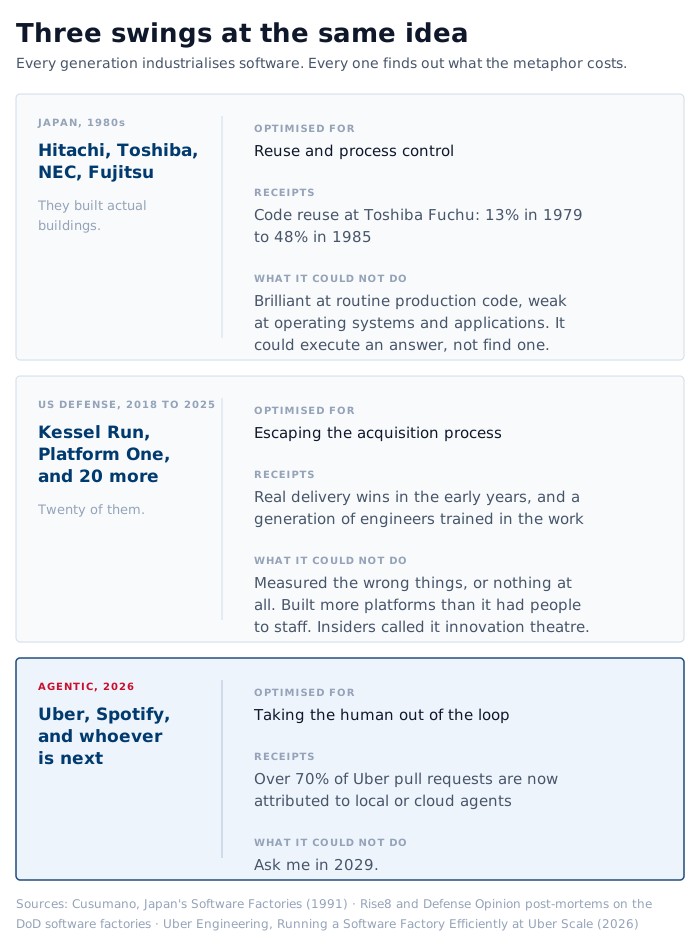
Software factories were tried in 1980s Japan and again across US Defense. Both fell short in the same way. The agentic version in 2026 is different in one specific respect, and it is not the agents.
Read
Most engineering orgs added AI but kept the rituals built for a slower era. Here are eleven things to retire this quarter, and what to replace them with.
ReadThe Engineering Manager role used to be one job. It is now two, and most orgs have not noticed. Here's the split, the second role, and how to staff it.
Read